
The biggest shift in B2B sales is moving from selling your solution to helping buyers confidently make a commercial decision. Businesses that win consistently aren't better at pitching, they're better at proving the problem, the cost of doing nothing and the ROI of change. That's problem-led growth, and it's the foundation of Sales Market Fit.
After 20 years in B2B sales, the biggest lesson I've learned is this: most businesses don't actually have a sales problem. They have a Sales Market Fit problem.
For years I thought the answer was to become a better salesperson. Better discovery, better objection handling, better closing. But after working with startups, scale-ups and enterprise software companies, I noticed something. The businesses winning consistently weren't better at selling. They were better at helping buyers buy.
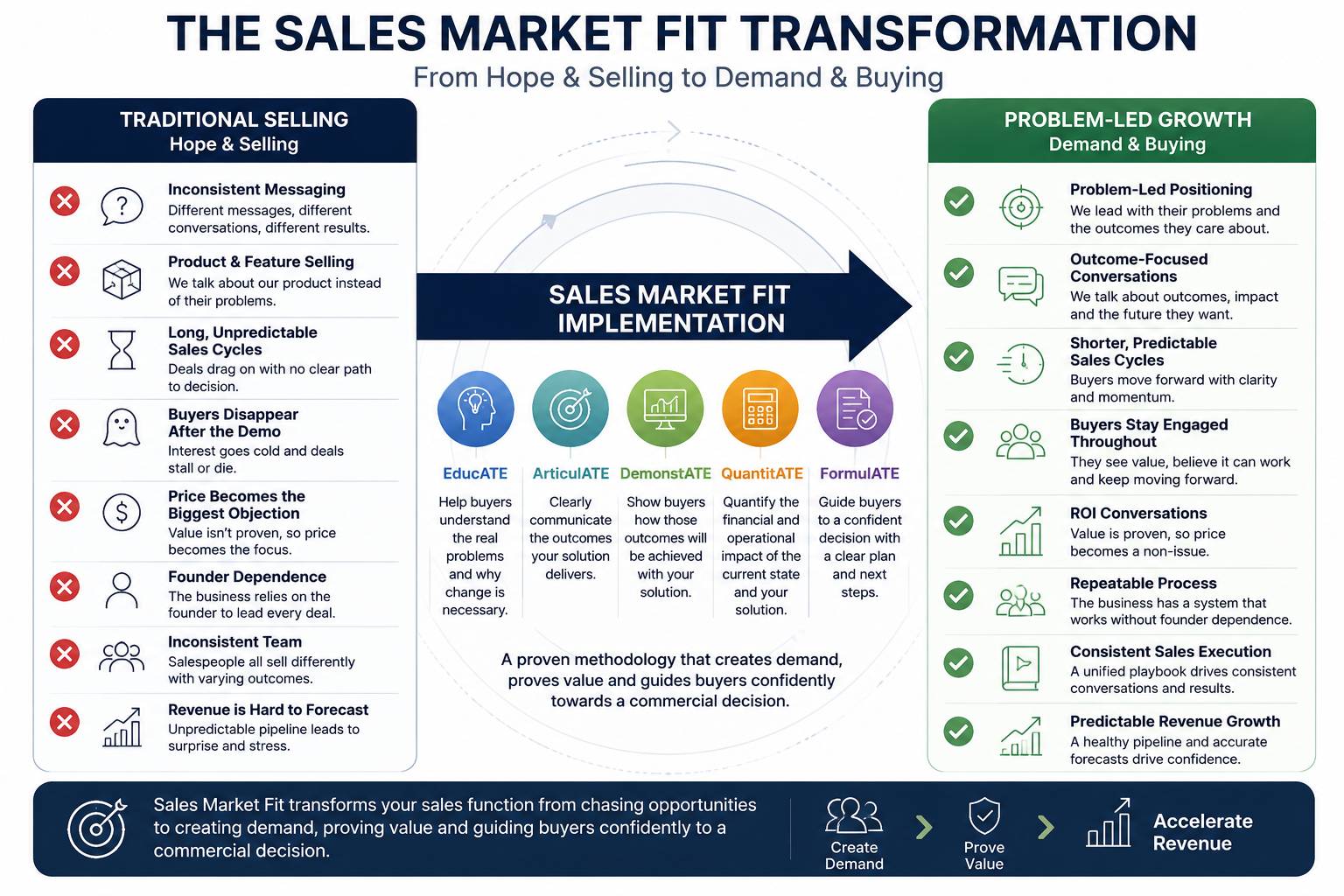
What does traditional selling look like?
Traditional selling is focused on the seller. It looks like this:
- Talking about products and features
- Running demonstrations
- Overcoming objections
- Chasing opportunities and following up repeatedly
- Hoping the buyer eventually says yes
When deals stall, the instinct is to push harder: more emails, another demo, another discount. But buyers rarely need more selling. They need more certainty.
What is problem-led growth?
Problem-led growth flips the question. Instead of asking "How do we sell our solution?", you ask "How do we help this buyer confidently make a commercial decision?" That means leading every conversation with:
- The problems they're trying to solve
- The business outcomes they want to achieve
- The financial impact of doing nothing
- The ROI of making a change
- A clear pathway to a confident buying decision
When buyers clearly understand the problem, the consequences of leaving it unsolved and the value of changing, you stop creating sales pressure and start creating demand.
What changes when your sales process matches the buyer's journey?
This is the philosophy behind Sales Market Fit, the 5ATE Method and DealBuddi. When your sales process aligns with how your buyer actually buys:
- Sales conversations become more valuable
- Demonstrations become more meaningful
- Price becomes easier to justify
- Sales cycles get shorter
- Buyers move forward with confidence
The goal isn't to become better at selling. It's to become better at helping people buy.
Frequently asked questions
What is problem-led growth in B2B sales?
Problem-led growth is a sales approach that leads with the buyer's problems, desired outcomes, the cost of inaction and the ROI of change, rather than leading with product features. The aim is to help the buyer make a confident commercial decision.
How is problem-led selling different from traditional selling?
Traditional selling focuses on the seller's product, demos and objection handling, then pushes harder when deals stall. Problem-led selling focuses on the buyer's decision, building certainty by proving the problem and the value of solving it.
Why do B2B deals stall even when buyers are interested?
Interest alone isn't enough to overcome the effort of buying. Deals stall when the buyer lacks certainty about the size of the problem, the cost of doing nothing or the return on investment.
What is Sales Market Fit?
Sales Market Fit is the alignment of your sales strategy and process with the predictable stages your target buyers go through to make a purchase decision. It was developed by Gavin Tye and underpins the 5ATE Method and DealBuddi.